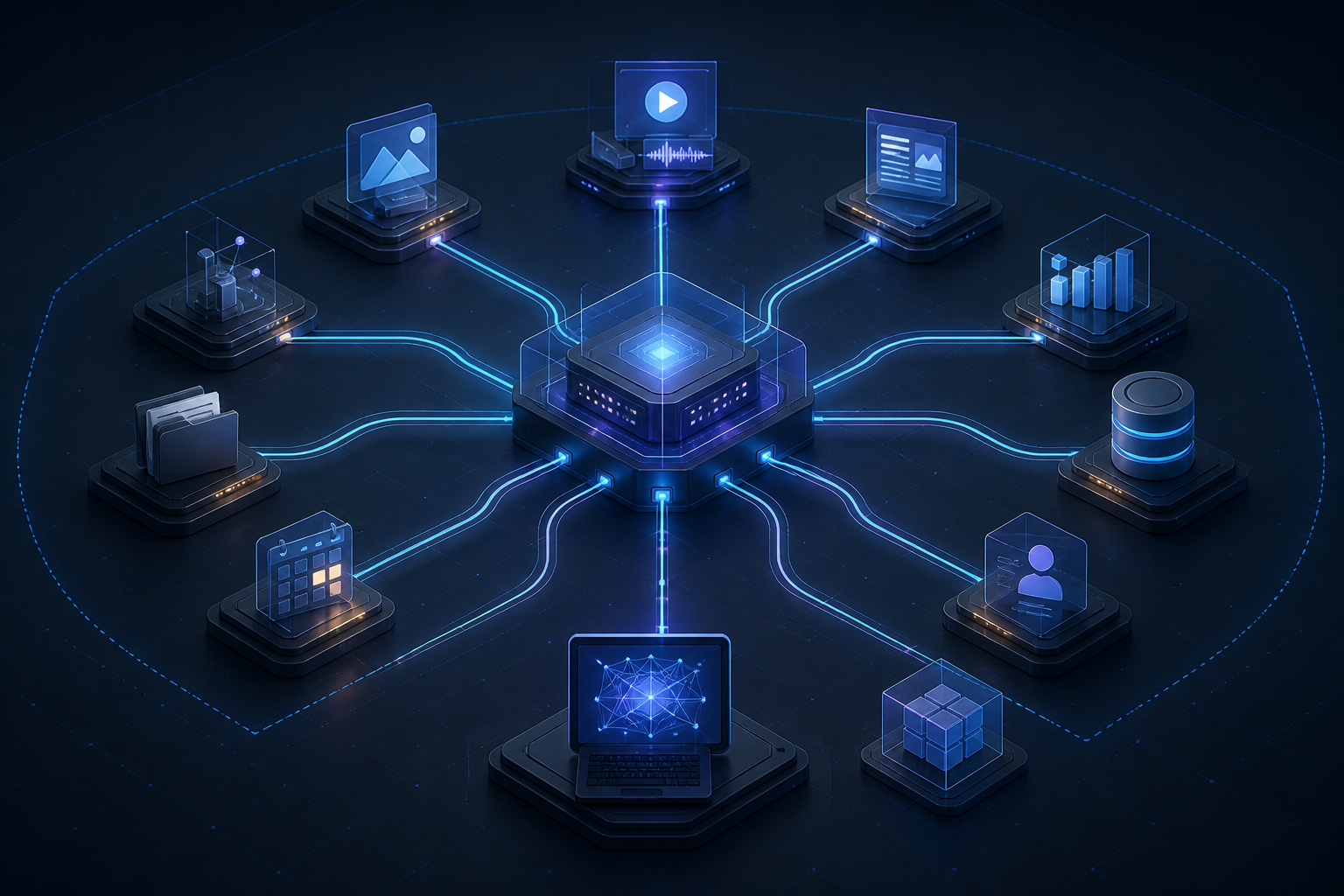
A Reusable Access Layer
I first built pages, a static-site host with an MCP upload tool. It was useful enough that I kept repeating the design. The cluster now has ten MCP servers: congress-mcp, freshrss-mcp, googlenews-mcp, gsc-mcp, jetlog-mcp, media-mcp, monica-mcp, nodebyte-mcp, pages, and the Kubernetes server.
Each server fronts one self-hosted application. The similarity is intentional. They share the manifest layout, bearer-token boundary, hostname convention, and deployment path. Adding the tenth took about forty minutes, most of it spent writing the tool descriptions that decide whether a client can use the server sensibly.
An API-backed application can take this shape without becoming public infrastructure. The client receives a narrow interface. The application stays behind the cluster boundary.
The Common Shape
Every server begins with the same directory:
00-namespace.yaml
11-secret.sops.yaml          # MCP_TOKEN and upstream credentials
20-deployment.yaml
30-service.yaml
53-httproute-internal.yaml   # <app>-mcp.internal.white.fm
60-networkpolicy.yaml
ksops.yaml
kustomization.yaml
Some services need an ExternalSecret or an additional registry credential manifest. The bones stay the same. I copy the directory, replace the application values, issue a fresh bearer token, and review the deployment, service, route, and network policy as a unit.
The hostname is always https://<app>-mcp.internal.white.fm/mcp, resolved by internal DNS. The pod receives MCP_TOKEN and its upstream credentials through a Kubernetes Secret generated from SOPS or an external secret. Kubelet probes can still reach /healthz. Each service has its own image, referenced through the internal registry and pinned in kustomization.yaml, with digests and Renovate annotations where the deployment uses them. A default-deny NetworkPolicy then admits only the Envoy Gateway namespace to port 8080.
The Interface Carries the Design
These are small FastMCP HTTP services using Streamable HTTP and a bearer header. A compatible client registers one with a command like this:
claude mcp add --transport http jetlog \
  https://jetlog-mcp.internal.white.fm/mcp \
  --header "Authorization: Bearer <MCP_TOKEN>"
The difficult part is the tool boundary. Function names, type annotations, parameter descriptions, server instructions, and docstrings all become part of the interface a model sees. A tool called add_flight with a one-line description invites malformed calls. One that names the date format, airport-code format, and duplicate check gives the client a workable path through the task.
That boundary should resemble the request a person makes. jetlog-mcp could expose each flight-log REST endpoint. Instead it offers parse_boarding_pass, check_duplicate, enrich_flights, get_statistics, and get_analytics, because the usual request is “log this flight from my confirmation email.” The underlying API sees a POST to /api/flights. The MCP server absorbs that translation.
Three Servers Worth Describing
media-mcp joins a stack of applications. It fronts the download-management and library services in my media stack, plus Plex and Tautulli. One endpoint can look up a film, add it to the appropriate workflow, trigger a search, request a Plex library scan, confirm that the item arrived, and inspect playback. The client does not need to coordinate a handful of unrelated APIs for one ordinary request.
monica-mcp smooths over the deployed Monica interface. Its Kubernetes deployment provides the Monica base URL, an account email, and a DAV token to the MCP container. The image handles the DAV layer and exposes higher-level operations. The client need not learn the upstream protocol to use the data.
gsc-mcp keeps browser automation out of API work. Search Console and IndexNow already expose APIs for submission and analytics. A browser is slower, more brittle, and forces credentials into a client session. The Google credential belongs in the service that needs it.
Security Notes
This fleet assumes a single-tenant cluster on a private tailnet. Internal hostnames, gateway-only NetworkPolicy ingress, and bearer tokens establish the present trust boundary. Credential-bearing services still deserve suspicion.
Every server holds credentials. media-mcp has several upstream API keys and tokens. gsc-mcp has a Google credential. A compromised server can expose the authority assigned to it. Each server in this fleet receives its own token. I treat every one as a production secret, even when the service feels like a convenience wrapper.
Tokens are static and unrotated. There is no rotation mechanism or client-specific scope. Ten servers mean ten long-lived secrets. I accept that on a private network. It is a poor default for a shared or public service.
Tool scope needs active restraint. googlenews-mcp has no arbitrary-URL fetch tool. Such a tool can turn a narrow capability into a general egress route. I wrote more about that constraint in No Proxy, No Fetch Tool.
media-mcp explicitly disables FastMCP’s DNS-rebinding protection. A private-network assumption does not substitute for Host and Origin validation at an HTTP MCP endpoint. I would review that setting before putting this service anywhere beyond the trusted network.
The Practical Result
The cluster has ten services, ten image builds, and one manifest pattern. The repetition is deliberately dull. That is the point. A new integration inherits a familiar way to authenticate, route, deploy, and review its access surface.
Related Posts
- Agentic Static-Site Hosting: Giving Claude a Place to Publish on Kubernetes — one of the ten, documented end to end.
- No Proxy, No Fetch Tool: Capability-Scoped Internet Access for In-Cluster Agents — the egress rules these servers are deployed behind.
- Hermes: Encrypted Conversation, Deliberate Authority — the agent that consumes this tool surface.
- One Ollama Endpoint, Two Very Different Backends — the inference endpoint an agent reaches for alongside these tools.
Questions or corrections? Start a Discussion on GitHub, submit a GitHub PR, or email me at [email protected].
Robert