A glowing agent inside a Kubernetes-style boundary connected through five narrow capability channels to a news globe, while red network routes are blocked outside the boundary

No Proxy, No Fetch Tool: Capability-Scoped Internet Access for In-Cluster Agents

Introduction Consider an agent running in a cluster or on a server that needs to read the news. The customary response is to provide an HTTP client and permit it to fetch URLs, perhaps through an egress proxy intended to impose a measure of network hygiene. The agent in question is an in-cluster assistant with material access to its environment. It can receive a projected ServiceAccount token, whose effective authority derives from Kubernetes RBAC; it can control home automation; and it can reach several important internal services. Giving a system with that degree of reach a general-purpose fetch(url) tool creates a direct security problem: every page it reads becomes a potential source of adversarial instruction, and every host on the internet becomes a potential destination for whatever information the agent can assemble. ...

August 10, 2026 · 7 min · Robert D. White
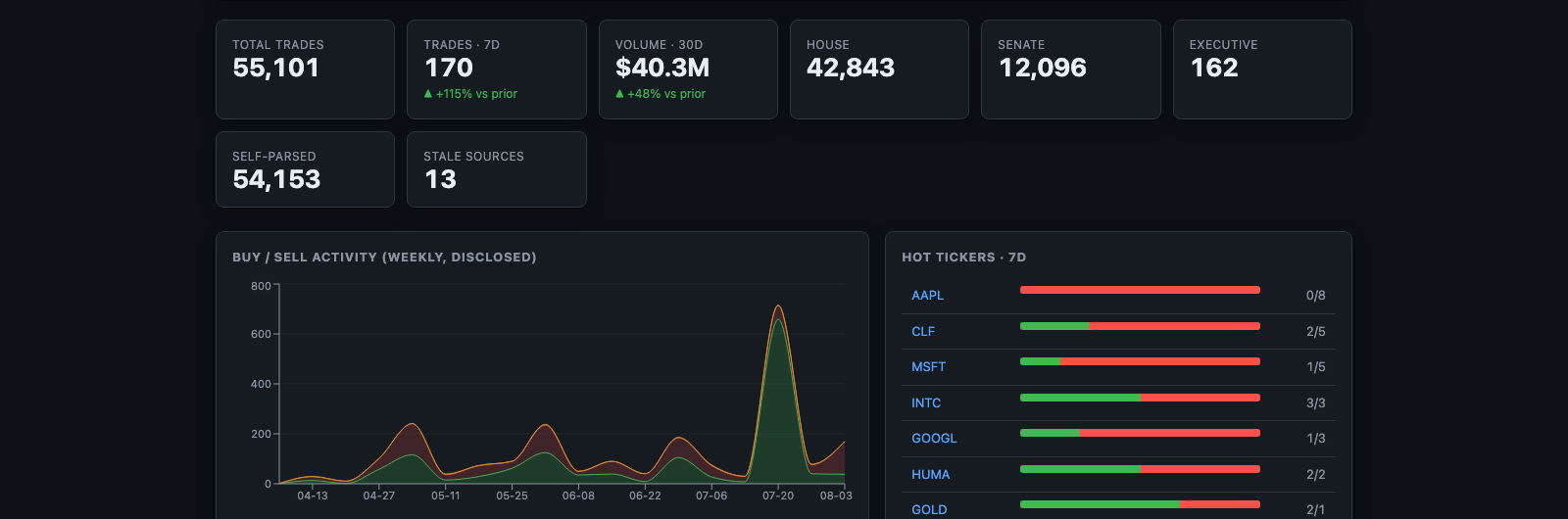
The congress-trades dashboard showing trade-count and volume KPIs, a weekly buy/sell chart, and a hot-tickers list

Parsing Every Congressional Stock Disclosure: Seventeen CronJobs and a Lot of Bad PDFs

Introduction Members of the United States Congress must disclose many securities transactions, and the resulting records are public. As a dataset, however, they are close to unusable: the House publishes a ZIP archive whose underlying filings are frequently scanned images; the Senate uses a separate system with its own irregularities; tickers are inconsistent or absent; and neither chamber provides an interface resembling a durable public API. Several commercial services solve this and sell the result. I wanted to see how much of it I could do myself, in-cluster, from the primary sources. ...

August 9, 2026 · 7 min · Robert D. White
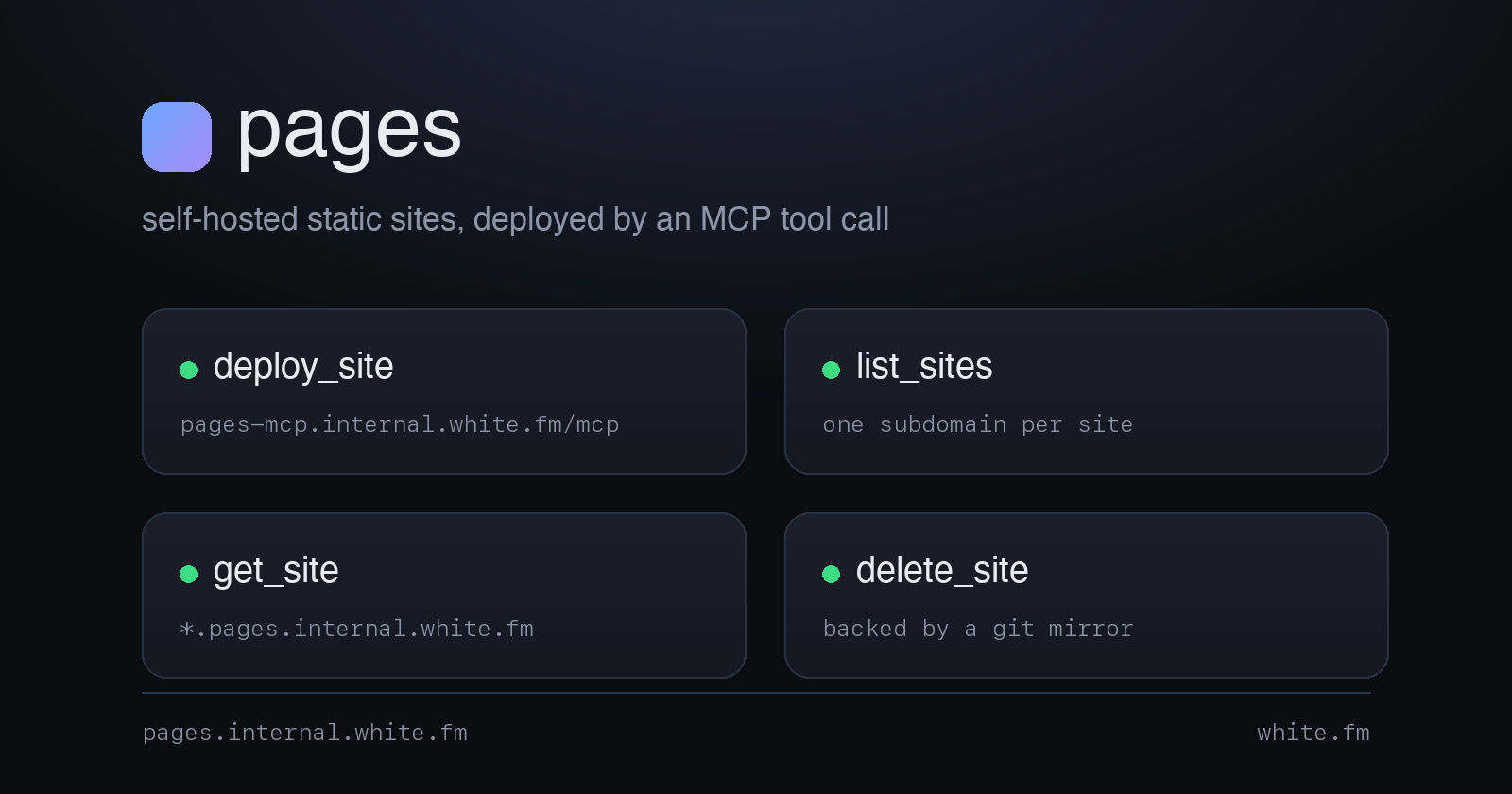
A dark title card for pages, listing its four MCP tools

Agentic Static-Site Hosting: Giving Claude a Place to Publish on Kubernetes

Introduction I use Claude Code for substantial one-off analysis, and its output is frequently a single self-contained HTML file. Examples include a flight-log dashboard, an interactive trainer derived from an audiobook transcript (described in Building Interactive Trainers From My Audiobook Library), a pedigree chart, and a client map. Each began either as a Live Artifact or as a file in /tmp that I opened with file://, inspected once, and subsequently lost. ...

August 8, 2026 · 18 min · Robert D. White
A dark card grid linking seven audiobook trainers

Building Interactive Trainers From My Audiobook Library

Building Interactive Trainers From My Audiobook Library I listen to a considerable number of business and leadership audiobooks, yet retain very little of their content a month later. Listening is passive; useful frameworks blur together with time; and “I read that one” readily becomes “I think I read that one.” I wanted the retention without replaying seven hours merely to recover the one idea I needed. I therefore built a compact production process that converts an audiobook into an interactive trainer, in which each concept and example becomes a card supporting three modes: Browse, Flashcards, and Quiz. Each book receives its own self-hosted site on my internal network; during a single afternoon, I applied the process to seven titles. ...

July 11, 2026 · 7 min · Robert D. White
A white rat in an intracranial self-stimulation apparatus, pressing against the lever in the chamber

The Lever and the Enter Key: A Conceptualization of Agent-Mediated Software Development as a Functional Analog of Brain Stimulation Reward

This essay is also available as a preprint on PsyArXiv. To cite it, use the following reference (APA 6th edition): White, R. D. (n.d.). The lever and the enter key: A conceptualization of agent-mediated software development as a functional analog of brain stimulation reward. Retrieved from https://osf.io/preprints/psyarxiv/zxpwg_v1 Abstract Olds and Milner (1954) reported that rats with electrodes implanted in the septal area would learn to lever-press for brief pulses of electrical stimulation delivered to the implant site, establishing what is now called brain stimulation reward (BSR) and its operant counterpart, intracranial self-stimulation (ICSS). Subsequent work demonstrated that rats stimulated in the lateral hypothalamus or medial forebrain bundle would respond at sustained high rates (Olds, 1958a) and would self-stimulate to physical exhaustion without satiation under extended testing (Olds, 1958b), would forgo food to the point of starvation when both food and stimulation were available concurrently (Routtenberg & Lindy, 1965), and would respond for brain stimulation in competition with shock avoidance (Valenstein & Beer, 1962). Researchers have since demonstrated the phenomenon in multiple species, including humans, with published case reports of compulsive self-stimulation that closely mirror the rodent literature (Bishop, Elder, & Heath, 1963; Moan & Heath, 1972; Portenoy et al., 1986). The purpose of this essay is to (a) review BSR and its proposed neural mechanism with appropriate hedging of the contested causal role of dopamine, (b) propose a structural analogy between BSR and the reinforcement profile generated by interaction with large language model (LLM) coding agents (e.g., Claude, Codex), and (c) clarify that the behaviors examined in this essay are conceptually distinct from the cluster of LLM-associated psychotic phenomena recently discussed in the clinical literature on so-called “AI psychosis” (Flathers et al., 2026; Morrin et al., 2026), which refer to delusion formation rather than compulsive use. I close with a personal observation, as the analogy did not become persuasive to me until I noticed it operating in myself. ...

May 26, 2026 · 15 min · Robert D. White
Available as a Tor onion service